Burial Site of Josette Beaubien
Franklin Park, Cook County, Illinois
Marker Inscription
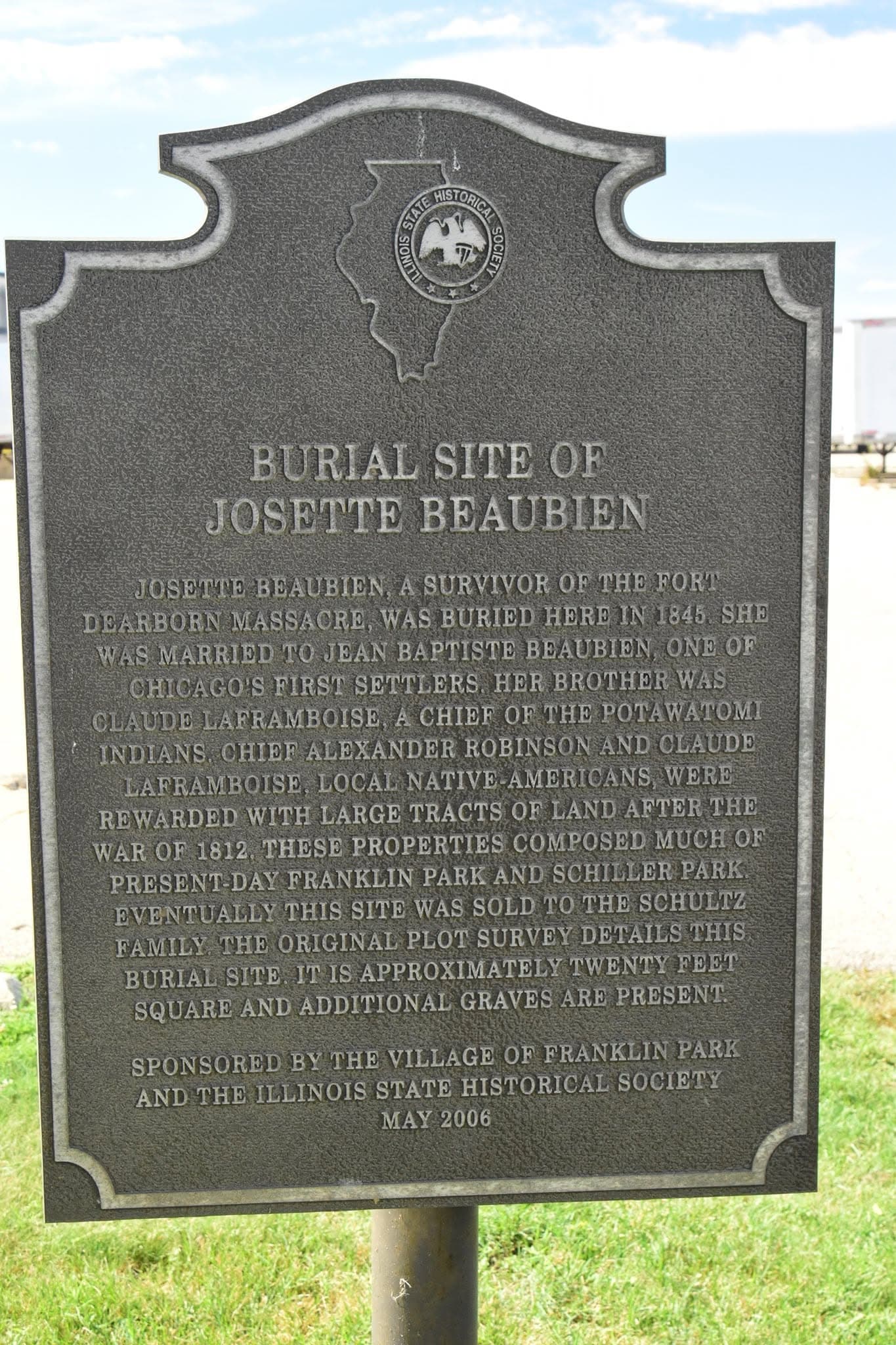
Josette Beaubien, a survivor of the Fort Dearborn Massacre, was buried here in 1845. She was married to Jean Baptiste Beaubien, one of Chicago's first settlers. Her brother was Claude LaFramboise, a chief of the Potawatomie Indians. Chief Alexander Robinson and Claude LaFramboise, local Native-Americans, were rewarded with large tracts of land after the war of 1812. These properties composed much of present-day Franklin Park and Schiller Park. Eventually this site was sold to the Schultz family. The original plot survey details this burial site. It is approximately twenty feet square and additional graves are present. Sponsored by the Village of Franklin Park and the Illinois State Historical Society May 2006
The Story
Josette Beaubien lived at the very hinge of Chicago's beginnings. She survived the 1812 Fort Dearborn engagement, married Jean Baptiste Beaubien—among the settlement's earliest permanent residents—and was sister to a Potawatomi leader, embodying the mingled French, American, and Native worlds of the frontier trading post that would become a great city. When she was buried here in 1845, Chicago was still a raw young town on the prairie.
Why it matters
Her life bridges Native, French, and American Chicago, a reminder that the metropolis grew out of a multicultural frontier crossroads long before the skyscrapers rose.
The story behind this marker
AI contextThe era
In the early nineteenth century, the place that would become Chicago was a raw frontier crossroads — a low, marshy meeting point of prairie, river, and lake where French, American, and Native worlds overlapped. This was the era of the Early Republic, when the young United States was pushing into the Old Northwest and the future metropolis was still just a scattering of traders, soldiers, and Native families around a small military post.
That post was Fort Dearborn, and the surrounding settlement drew people who lived across cultural lines: French-descended fur traders, their Native kin and partners, and the earliest American settlers, all bound together by trade and intermarriage. It was a world where a single family might carry French, American, and Potawatomi ties at once.
Into this borderland the War of 1812 arrived with sudden violence, and the events of 1812 near Fort Dearborn became a founding trauma in the region's memory — the frontier's peril made real at the very spot where a great city would later rise.
People & events
Josette Beaubien lived at the hinge of that history. The marker records that she was a survivor of the Fort Dearborn Massacre, the deadly 1812 engagement that scattered the settlement around the fort. To have lived through that day and then to have remained as the region grew is itself a remarkable thread of continuity.
Her family embodied the frontier's mingled worlds. She was married to Jean Baptiste Beaubien, remembered as one of Chicago's first settlers, placing her at the center of the tiny community that would become a city. Her brother was Claude LaFramboise, a chief of the Potawatomi, and the marker also ties her story to Chief Alexander Robinson — names that together bridge the Native and settler communities of the early lakeshore.
When Josette Beaubien was buried here in 1845, Chicago was still a young town finding its shape on the prairie. Her grave marks not only one life but a whole generation of people who stood between eras — survivors of frontier violence who lived to see the beginnings of the modern city.
Its place in the American story
Chicago is often remembered for its skyscrapers and railroads, but its origins lie in exactly the kind of multicultural frontier crossroads that Josette Beaubien's life illustrates. Before the great city, there was a trading settlement where French, American, and Native peoples met, traded, married, and sometimes clashed — and that mingled beginning is part of the American story writ large.
Her connection to the Fort Dearborn events ties this quiet burial site to a national narrative: the War of 1812 on the western frontier, and the often violent, always complicated encounter between the expanding United States and the Native nations of the interior. Her family's Potawatomi ties are a reminder that the land Chicago rose upon was Native ground first.
A grave like hers insists that the metropolis did not spring from nothing. It grew out of real people who lived at the meeting of cultures, and remembering them keeps the fuller, more human story of American growth from being paved over.
If you visit
The burial site lies in Franklin Park, in Cook County, within the modern sprawl that long ago swallowed the frontier Josette Beaubien knew. Approach it as a place of quiet reflection rather than spectacle — a marked grave that asks you to slow down and consider the distance between her world and the one around you now.
Standing here, try to hold both eras in mind at once: the young prairie town of 1845 where she was laid to rest, and the vast metropolitan region that grew up over the following generations. That contrast is the real experience the site offers.
For a traveler interested in the deeper roots of Chicago, this makes a meaningful stop, best paired with a bit of reading about the frontier settlement and the Fort Dearborn events her life touched. Give it a contemplative few minutes; markers like this one preserve the memory of the people who were there at the beginning, long before the skyline rose.
Written by AI to add context, grounded in the marker’s inscription and the historical record. The inscription above is the original, unaltered text.
Own a business near here? Add it to the map.
Related people
- · Josette Beaubien
- · Jean Baptiste Beaubien
- · Claude LaFramboise
- · Alexander Robinson
Related events
- · Fort Dearborn Massacre
Themes & tags
Nearby & related markers
Eel River Post-Fort
Whitley County, IN
This ground carries layers of frontier history: a Miami trading post stood here by 1762, and in 1779 the war leader Little Turtle fortified the place during the turbulent years of Native resistance in the Old Northwest. After the 1795 Treaty of Greenville brought an uneasy peace, a house was built for Little Turtle here. When American forces under Colonel Simrall razed the fort in September 1812, at the outbreak of the War of 1812, his dwelling was deliberately spared.
Marquette Monument
Chicago, IL
French Jesuit priest Jacques Marquette spent the winter of 1674–1675 camped near this spot on his mission to the Illinois Indians, in what would become Chicago. His journal was among the first accounts to describe the region's rich soil, favorable climate, and natural advantages for travel and trade. This monument honors that early encounter at the future site of a great American city.
Site of Kendall County's First Store
Newark, IL
Near this site stood Kendall County's first store, built by George Hollenback, until it was burned in May 1832 during the Black Hawk War. That conflict — sparked when Sauk leader Black Hawk led followers back across the Mississippi to reclaim ceded homelands — swept panic and violence across northern Illinois, driving scattered settlers to flee or fort up.
Chief Shauwanasee Memorial
Kankakee County, IL
This memorial honors Chief Shau-wa-na-see, a Potawatomi leader associated with the Kankakee River country of Illinois around 1838 — the very years when the United States forced the Potawatomi from their homelands in the region during Indian Removal. The date marks an era when Native nations of the Old Northwest were being pushed west of the Mississippi.